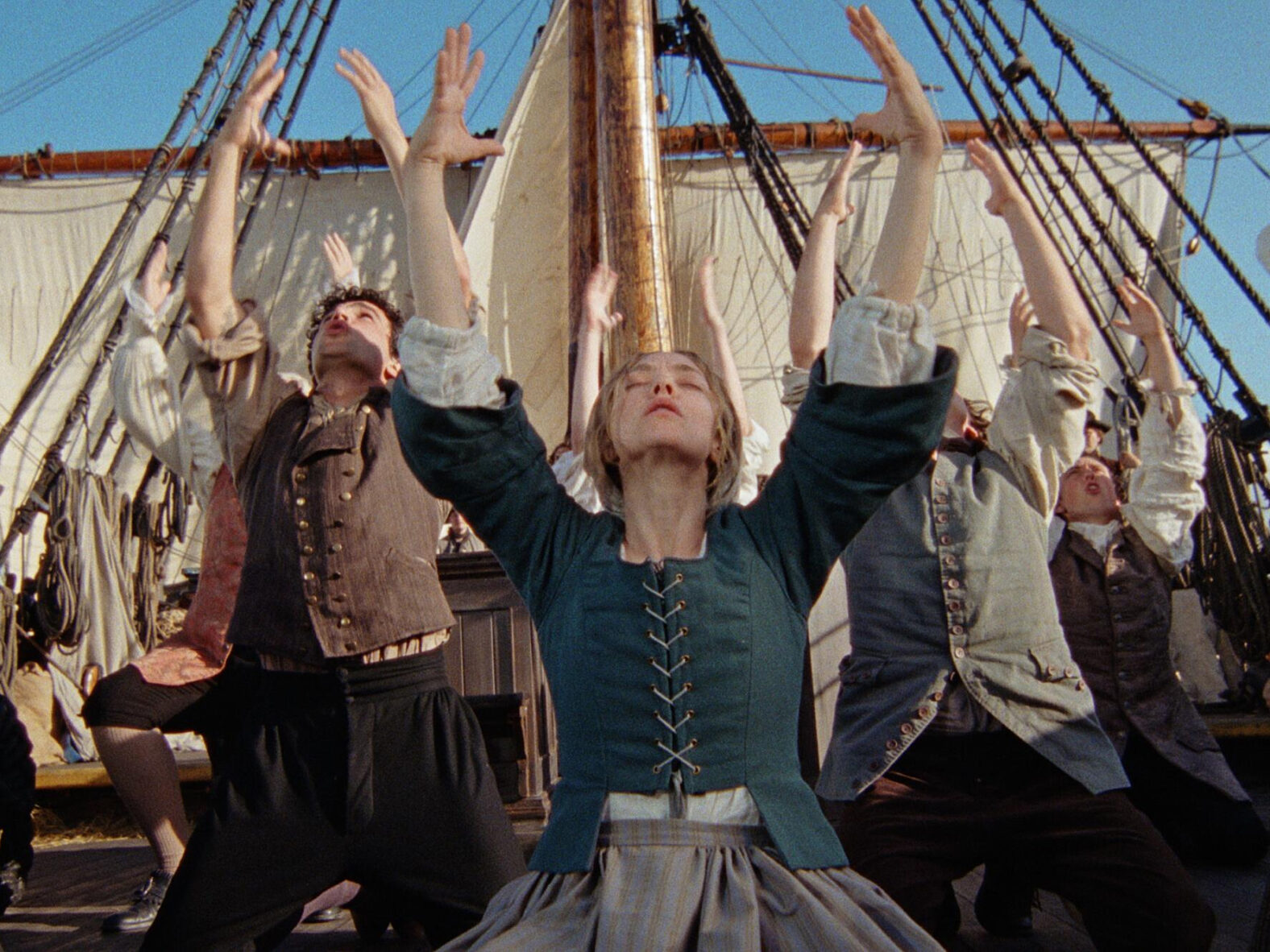
Directed by Mona Fastvold (The Brutalist) and co-written by Fastvold and Brady Corbet (Melancholia, Mysterious Skin), The Testament of Ann Lee is a historical musical drama following the trials and life of America’s first recorded female preacher and leader of the Shaker Movement, Ann Lee and starring Amanda Seyfried with support from Lewis Pullman and Thomasin McKenzie.
Born during the Evangelical revival of England, Ann Lee was always devout in her faith. Deeply pious, Ann and her brother William are drawn to join a group of Quakers who proclaim that the second coming of Christ will be a woman; their practice embraces equality among the sexes and uses song and dance as a means of prayer, giving them the name “shaking Quakers”. Ann soon finds herself becoming a fixture within their community. Compelled to spread the word across the colonies, Ann, William, and a small number of Shakers migrate to the Americas and build a community in New England. But the process is never easy, and Ann finds herself the target of Christian heretics both at home and abroad.
Admittedly, I didn’t find much appeal in The Testament of Ann Lee. As someone who grew up being forced to attend church and, as a result, developed a general dislike for organised religion, stories of faith don’t really interest me unless they’re being featured in a true crime documentary. And if you’ve been following my film coverage over the years, you’d be well aware that my taste skews to the somewhat “low-brow” end of the scale, so a film of this depth and magnitude sadly fell flat for me. The run time of almost 2.5 hours was, for me at least, far too long and I found myself unable to relate to any of the characters in any meaningful way.
However, by no means is The Testament of Ann Lee a bad film. On the contrary, Fastvold has created something that I would not hesitate to call art. Cinematographer William Rexer has an incredibly sharp and considered eye and was somehow able to make England and America of the 1700s feel very rich, full-bodied, and powerful. A nice visual touch were the title cards used to frame the moments of Ann’s life from childhood to death; their appearance on screen helped to make this mammoth of a film feel somewhat more digestible.
The music of The Testament of Ann Lee, composed and produced by Daniel Blumberg, featured original songs inspired by Shaker hymns that were a little jarring on the ear. Similar to the songs of La La Land, I liked that they were intended to be performed spiritedly rather than perfectly, however, this did often result in the lyrics being unintelligible between all the grunting and moaning. Ultimately, I think I would have liked some sharper sound mixing in the larger group prayer scenes to help offset this issue.
The biggest saving grace for The Testament of Ann Lee is, of course, the incredible Amanda Seyfried. Perhaps owing to her history with musical performances (see: Mamma Mia! and its sequel), Seyfried was one of the only performers in the cast whose voice could be fully understood throughout the musical numbers.
Her physicality throughout the film was also remarkable and fluid, moving through each prayer dance with a truly singular power. While her Northern English accent sometimes faltered, her performance overall was captivating from beginning to end. When she wasn’t on screen, I longed to see her; no disrespect intended to her supporting cast, but none of them had the strength to carry the narrative the way Seyfried did.
So, what does all this boil down to? While The Testament of Ann Lee can definitely be called a career best for Amanda Seyfried. Overall, this attempt at centring the life of a markedly influential woman was just okay, and I can’t say that I’ll be eager to sit through it for a second time. But if you like slightly avant-garde musicals with a bloated running time, congrats: this is the film for you.